 Ultimate guide
Fair Market Value Gold Bullion: A Complete Guide
Last Updated: November 16, 2026
Quick Summary
Fair market value gold bullion is the price a willing buyer and willing seller would agree on when neither is under pressure to act and both know the market. It differs from the spot price and from an insurance appraisal, which values replacement cost at retail. Most sellers expect spot but receive spot minus the dealer spread.
- Spot price is a wholesale benchmark for large institutional bars, not a retail offer for your coin or bar.
- Estimated buyback equals spot times troy ounces times purity, minus the dealer spread and transaction fees.
- One troy ounce equals 31.1035 grams, about 10% more than an avoirdupois ounce of 28.3495 grams.
- At a hypothetical $2,000 spot, one gram of fine gold works out to roughly $64.30 before any spread.
- Keep the original assay card and packaging, because a sealed recognized bar typically commands a better buyback.
Table of Contents
- What Fair Market Value Means for Gold Bullion
- Using a Fair Market Value Gold Bullion Calculator
- Fair Market Value Gold Bullion per Gram
- Reading a Fair Market Value Gold Bullion Chart
- What the 1 oz Gold Bar Price Today Tells You
- How Premiums, Spreads, and Fees Affect Your Payout
- Valuing Bullion by Purity and Condition
- Tax, Estate, and Insurance Valuations
- Getting a Private Evaluation Before You Sell
- Frequently Asked Questions
What Fair Market Value Means for Gold Bullion
Fair market value gold bullion is the price a willing buyer and a willing seller would agree on when neither is under pressure to act, and both have reasonable knowledge of the market.
Sellers often find that the gap between those numbers is where most disappointment starts. The IRS definition of fair market value uses similar language: the price at which property would change hands between a willing buyer and a willing seller, neither being forced to buy or sell.
Three numbers exist for the same gold bar, and they rarely match:
- Spot price: the wholesale benchmark for one troy ounce of fine gold
- Dealer price: spot plus a premium when you buy
- Buyback price: spot minus a spread when you sell
Most sellers walk in expecting the first number and hear the third. Understanding why is the whole game.
Spot Price Is the Starting Point, Not the Offer
The spot price is a benchmark for large, standardized contracts, not a retail quote. It reflects large good delivery bars traded between institutions. A 1 oz coin is not that product, and retail items generally do not sell at institutional pricing.
Think of spot as the raw material cost. A dealer still has to verify purity, absorb price risk between purchase and resale, and cover refining or assay costs when they apply.
Why Insurance Appraisals and Buyer Offers Diverge
An insurance appraisal answers a different question than a buyer offer. The appraiser values replacement cost: what it would take to buy that same piece new, at retail, from a dealer, today. That number includes the retail premium, sales tax where applicable, and often a cushion for hard-to-find items.
A buyer offer answers what the item is worth in its current form, to someone who must resell it. Same coin, two questions, two answers. Neither is dishonest. They are simply not comparable, and treating them as comparable is one of the most common mistakes we see.
Using a Fair Market Value Gold Bullion Calculator
A fair market value gold bullion calculator is a tool that multiplies the current spot price by fine-gold weight, then adjusts for the dealer spread and any transaction costs, to estimate a realistic range for what you can pay or receive. Its value is not precision; it is a sanity check before you accept any offer or quote.
Here is the formula we would use, and you can run it yourself:
Estimated buyback = (spot price × troy ounces × purity) × (1 − dealer spread) − transaction fees
Worked example with round numbers to show the mechanics, not a live quote:
- Spot price: $2,000 per troy ounce
- Your item: 1 troy ounce .999 fine
- Dealer spread: 5%
- Assay or refining fee: $0 on a sealed, recognized bar
- Estimated buyback: $2,000 × 1 × 0.999 × 0.95 = $1,899
Run the same math at a 3% spread and you get $1,940. At 8%, $1,840. The spread is the variable that moves your number most, and it is the one worth asking about directly.
Where the Money Actually Goes
A calculator that only subtracts a spread hides the other deductions. The real gap between spot and a final check typically comes from several places, and each can be quoted separately:
- Dealer premium on a purchase: added to spot when you buy, covering fabrication, packaging, and distribution. On a 1 oz recognized bar this is often a modest percentage; on a 1-gram bar the same fixed costs are spread over far less metal, so the percentage looks much higher.
- Bid-ask spread on a sale: the gap between what a dealer pays and what it resells for. This is the dealer's gross margin and the single largest variable in a buyback quote.
- Refining or assay fee: applies when metal must be melted and re-certified, common with scrap, mixed lots, or damaged pieces, and usually avoidable on a sealed bar with a recognized refiner's mark.
- Shipping, insurance, and storage: relevant if you are buying online or holding metal in a vault. These are real costs of ownership and belong in any comparison of two offers.
A common pattern is two offers that look close on the headline number but diverge once fees are applied. A slightly lower offer with no assay charge can beat a higher offer that deducts one. Ask for the final check amount, after everything, and compare that figure.
Running the Formula on a Coin and a Bar
Take a 1 oz American Gold Eagle. It is 22-karat, .9167 fine, and contains one full troy ounce of fine gold, so the fine-gold content is 1.0 troy ounce even though the coin weighs slightly more than an ounce.
Now take a 100-gram .999 fine bar. That is 100 ÷ 31.1035 = 3.215 troy ounces of fine gold.
Two cautions. First, a calculator using yesterday's spot price is already wrong; check the live gold price from the World Gold Council before you run the numbers. Second, a calculator cannot see condition, rarity, or numismatic value, so treat its output as a floor for bullion, not a verdict on a collectible coin.
Watch out: some online calculators quietly use an avoirdupois ounce (28.3495 grams) instead of a troy ounce (31.1035 grams), which understates metal content by about 10%. Confirm the unit before you trust the output.
Fair Market Value Gold Bullion per Gram
Fair market value gold bullion per gram is simply the per-ounce figure divided by 31.1035, the number of grams in a troy ounce. Getting this conversion right prevents the single most expensive arithmetic error in gold selling.
A troy ounce is not an avoirdupois ounce. It weighs about 10% more.
| Unit | Grams | Common Use |
|---|---|---|
| Troy ounce | 31.1035 | Bullion coins and bars |
| Avoirdupois ounce | 28.3495 | Food, postal weight |
| Gram | 1 | Small bars, scrap pricing |
| Kilogram | 1,000 | Large bars, institutional |
Grams
At a hypothetical $2,000 spot, one gram of fine gold works out to roughly $64.30 before any spread. A 100-gram bar at the same spot carries about $6,430 of metal content.
Small bars and grams carry proportionally higher premiums than 1 oz items, because fabrication and handling costs are spread over less metal.
Reading a Fair Market Value Gold Bullion Chart
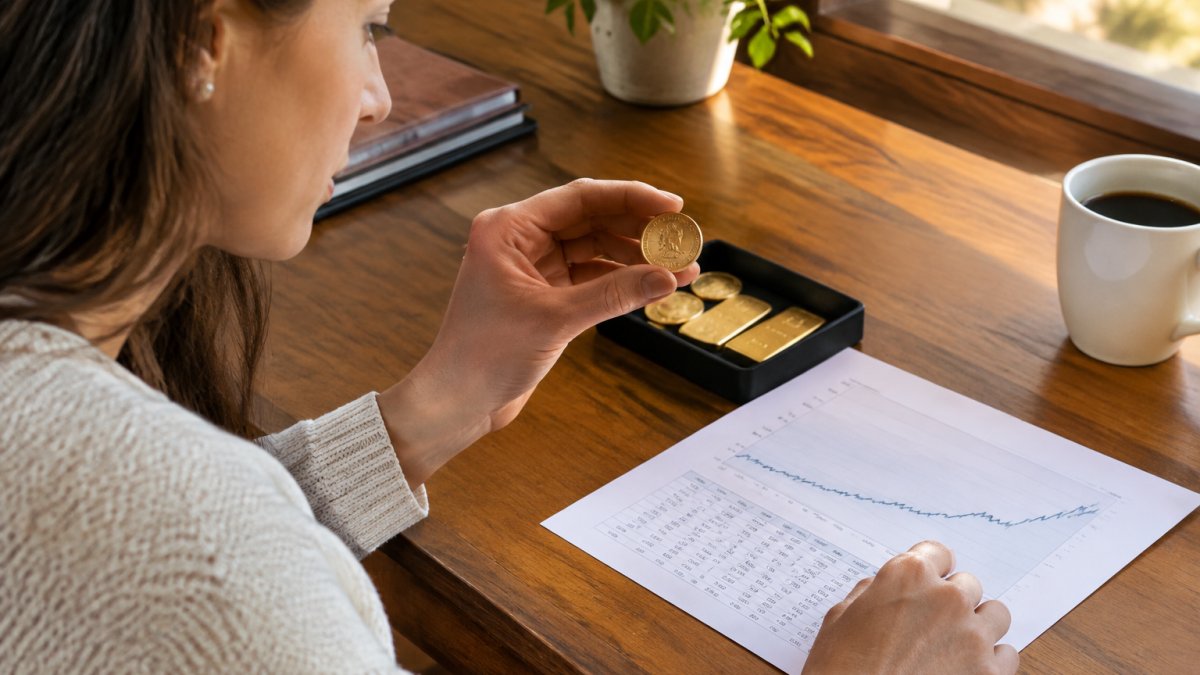
A fair market value gold bullion chart plots price over time so you can see the trend rather than a single frozen quote.
What to look at, in order:
- The 24-hour price trend: shows whether today is a high or low day within the recent range
- The daily price change: a large move means a dealer is carrying more risk and may widen the spread
- The longer historical price line: context for whether now is a reasonable moment to sell
- The timestamp and unit: a quote without a time and a unit (per troy ounce, in U.S. dollars) is not a usable number
Market volatility cuts both ways. On a violent up day, some buyers quote conservatively because the price may fall before they can resell. That is a risk-management decision, not a penalty aimed at you.
Turning a Chart Reading into a Valuation
A chart becomes useful when you convert it into a range. Suppose the chart shows spot at $2,000 per troy ounce and up 1.5% on the day. For a 1 oz .999 fine bar, the metal value is about $2,000 before any spread.
A common pattern is that sellers anchor on the highest number they saw on a chart that day and treat anything below it as a bad offer. The chart never included a spread, so the comparison was never apples to apples.
Checking the Quote Behind the Chart
Charts on unfamiliar sites often lag by hours, show a different contract month than the one dealers actually quote, or display a currency other than U.S. dollars. Before you treat a number as current, run a short checklist:
- Confirm the timestamp and time zone
- Confirm the unit is a troy ounce, not an avoirdupois ounce or a gram
- Confirm the currency is U.S. dollars
- Cross-check the figure against a second independent source
- Ask the dealer which quote and which spread its offer is based on
Watch out: a chart labeled only "gold price" may be showing a futures contract for a later delivery month rather than the spot price a dealer uses for a buyback, and the two can differ by more than the spread itself.
What the 1 oz Gold Bar Price Today Tells You
The 1 oz gold bar price today tells you the retail cost of buying that bar new, which is spot plus a fabrication premium. It is a useful reference point, but it is the wrong number to expect when selling.
Buy and sell prices sit on opposite sides of spot, and the distance between them is the bid-ask spread. When you buy, you pay the ask. When you sell, you receive the bid.
Premiums on 1 oz bars vary by maker, packaging, and whether the bar is in an assay card.
How Premiums, Spreads, and Fees Affect Your Payout
Premiums, spreads, and fees are three separate deductions, and lumping them together hides where your money went. Ask for each one separately, in writing if you like.
- Dealer premium: added to spot when you buy, covering fabrication and distribution
- Bid-ask spread: the gap between buy and sell prices, the dealer's gross margin
- Refining or assay fee: applies when metal must be melted and re-certified
- Administrative or shipping fees: less common on in-person local sales, but worth confirming
A common mistake is comparing two offers on the headline number alone. A slightly lower offer with no fees can beat a higher offer that deducts an assay charge. Ask what the final check amount is, after everything, and compare that figure.
What most sellers miss is that the spread is negotiable on larger or cleaner lots. A single coin in a sealed assay card requires almost no work to resell. A bag of mixed, unmarked scrap does.
Valuing Bullion by Purity and Condition
Purity and condition determine how much of the spot price your item actually captures.
Fineness is expressed in parts per thousand: .999.9167.900. Karat is the same idea in twenty-fourths. The conversion is straightforward once you know the stamp:
| Marking | Fineness | Fine Gold Content |
|---|---|---|
| 24K / .999 | 99.9% | Nearly all |
| 22K / .9167 | 91.67% | Most |
| 18K / .750 | 75.0% | Three quarters |
| 14K / .585 | 58.5% | A bit over half |
| 10K / .417 | 41.7% | Under half |
Condition matters most for coins with numismatic value. A rare date in original condition can be worth far more than its melt value; the same coin cleaned or scratched drops to bullion pricing.
If you want to see the specific bullion coins and bars we handle, you can browse bullion coins and bars before your visit.
Tax, Estate, and Insurance Valuations
Three formal valuations use fair market value, and each serves a different purpose. Confusing them creates paperwork problems later, so it helps to know which one you actually need.
- Tax valuation: establishes a cost basis or reports a disposition. The IRS guidance on capital gains for collectibles sets out how gains on precious metals are treated, and it is worth reading before you file.
- Estate valuation: values holdings as of the date of death for estate purposes. Heirs often need a written valuation, not just an offer.
- Insurance valuation: replacement cost, as discussed above, and usually the highest of the three.
For estate work, families who are not ready to decide can still request a valuation.
One practical note: keep your original purchase receipts. A documented cost basis is far easier to work with than a reconstructed one, and it can materially change the tax outcome on a large estate collection.
Getting a Private Evaluation Before You Sell
A private evaluation gives you a written, itemized number before you commit to anything.
We examine authenticity, purity, weight, and condition, and we explain the figure behind an offer. If you have an offer from another buyer, we can provide a second opinion.
To arrange a visit, you can book a private evaluation in Plano, find our Dallas location, or compare both locations and hours.
The gap between what you hoped for and what a buyer can pay is almost always explainable. Ask us to explain it. That is what we are here for.
Frequently Asked Questions
How do you calculate the fair market value of gold bullion?
Start with the current spot price per troy ounce, then divide by 31.1035 to get the price per gram. Multiply that by the item's fine gold weight, which is total weight times purity. That gives the melt value. Fair market value then adjusts for dealer premiums on the buy side and, when selling, the spread the buyer keeps. A 1 oz .999 fine bar is worth close to spot; a circulated coin or jewelry piece typically trades below it.
Why can a buyer's offer be lower than the gold spot price?
The spot price is a wholesale benchmark for large, standardized lots, not what a single seller receives. Buyers cover refining costs, assay and authentication time, holding risk while prices move, and their own operating margin. That gap is the bid-ask spread. For recognizable bullion bars and coins the spread is usually narrow; for mixed jewelry or items needing testing, it widens. Ask the buyer to break down how they arrived at the number.
How much is gold bullion worth per gram?
Divide the current price per troy ounce by 31.1035, then multiply by the item's fineness. A 1 oz .999 fine bar contains 31.1035 grams of fine gold, so its per-gram value tracks spot closely. A 14-karat piece is roughly 58.3% gold, so only that portion counts. Because spot moves throughout the trading day, check a live quote at the moment you request an offer rather than relying on a figure from earlier in the week.
Are gold bars hard to sell?
Standard, recognizable bullion bars from established refiners are among the easiest gold items to sell because their weight and purity are stamped and verifiable. The main variables are the bar's size and whether it comes with original packaging or an assay card. Large bars can narrow the pool of buyers, while 1 oz and smaller bars move quickly. Expect a price close to spot minus a small spread for investment-grade bars.
Can you explain the gap between my insurance appraisal and a buyer's offer?
Insurance appraisals are replacement-value figures: what it would cost to buy the same item new at retail, often including design, craftsmanship, and markup. A buyer's offer reflects liquidation value, which is closer to what the item can be resold or refined for. Both numbers can be correct for their purpose. Ask for a written explanation of how the offer was calculated so you can compare it against the appraisal line by line before deciding.
How can I check the value of a gold bar or coin before selling?
Confirm three things: the item's fine gold weight, its purity, and the current spot price. Weigh the piece on a calibrated scale, read the fineness stamp or assay card, and pull a live quote. Then apply the formula: weight in grams times purity times price per gram. Compare that melt value against offers you receive. For rare or collectible pieces, ask for the market data behind the offer so you can judge whether a numismatic premium applies.
